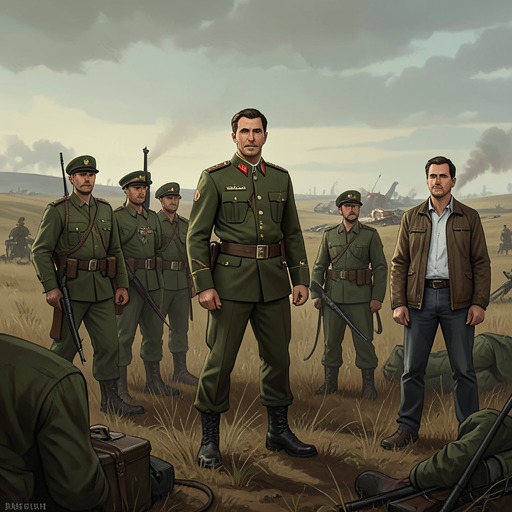
German Army
Journey to the End of the NightThe German Army appears in the novel as the force firing at Bardamu and his regiment, yet it remains largely distant and indistinct. That distance sharpens the book’s central irony: the supposed enemy is made up of people whom the narrator can remember as familiar, while the machinery of war turns them into targets and makes their deaths seem both arbitrary and officially acceptable.
The opposing force at the front
Bardamu first sees two Germans far down a road, firing toward the position where he and his colonel have stopped. Their presence offers no explanation for the battle. The colonel may understand why the shooting has begun, Bardamu allows, and the Germans may understand it too, but he does not: from his perspective, the opposing army has opened fire without warning or introduction.
The bullets pass close overhead as the regiment remains exposed. When the Germans change to a machine gun, the volume and reach of the attack become unmistakable, though the shooters themselves remain at the far end of the road. The episode presents the German Army through its effects on those under fire rather than through any account of its organization, aims, or individual soldiers’ motives.
Familiarity and estrangement
Bardamu’s resistance to national hatred rests on personal memory. He had attended school in Germany near Hanover as a child, spoke German, and remembers going into the woods with German boys, playing with inexpensive popguns or pistols, and drinking sweet beer. That history does not make the present danger less real, but it leaves him unable to regard the Germans as an abstract, naturally hostile people.
The mismatch between remembered familiarity and present violence makes the battle appear senseless to him. He says that his feelings toward the Germans have not changed, even as he recognizes their brutality and desperately wants to get away. His bewilderment is not a claim that the opposing force is harmless; it is a refusal to treat the outbreak of organized killing as self-explanatory simply because the men belong to different armies.
Violence and the war’s machinery
The German soldiers are visible only as distant figures, but their fire sets the scene’s immediate stakes. Bardamu and the colonel occupy the same exposed position while bullets cross the road, and Bardamu experiences his own presence there as uselessness rather than purposeful service. The military setting supplies no personal cause for the attack that he can understand, only its lethal consequences.
After the Germans begin firing the machine gun, a messenger reports that Sergeant Barousse has been killed. The report makes the distant exchange concrete: the shooting has taken a named soldier from Bardamu’s own side. Yet the narration offers no corresponding German identity or account of what their fire is meant to accomplish, preserving the asymmetry between the intimate knowledge of a death among comrades and the facelessness of the force that caused it.
The wider military routine continues to place the two armies in intermittent contact. Weeks later, after a short rest, Bardamu’s regiment rides north in cold weather. It encounters Germans only occasionally, and the soldiers retreat as soon as they see them; in each encounter, two or three horsemen are killed, sometimes German and sometimes French. The riderless horses cross the distance between the armies, approaching the other side’s animals and making an unexpected contrast with the men’s inability to do the same.
Narrative significance
The German Army is a necessary presence in the battle, but the novel does not use it to construct a conventional portrait of an enemy nation. Its soldiers appear at a distance, through gunfire and brief encounters, while Bardamu’s memories insist that the people on the other side were once ordinary companions. This contrast directs attention away from patriotic explanations and toward the violence that military divisions make possible.
The episodes also resist the idea that combat is inherently meaningful or heroic. German fire kills French soldiers; French and German cavalrymen alike fall in later encounters; and the living men repeatedly flee when the opposing force comes into view. The German Army’s narrative function is therefore not to embody a fully explained national character, but to mark the other side of a conflict that Bardamu experiences as an impersonal, reciprocal catastrophe.